
The keel of the Finnish Border Guard’s second patrol vessel was laid in traditional ceremony
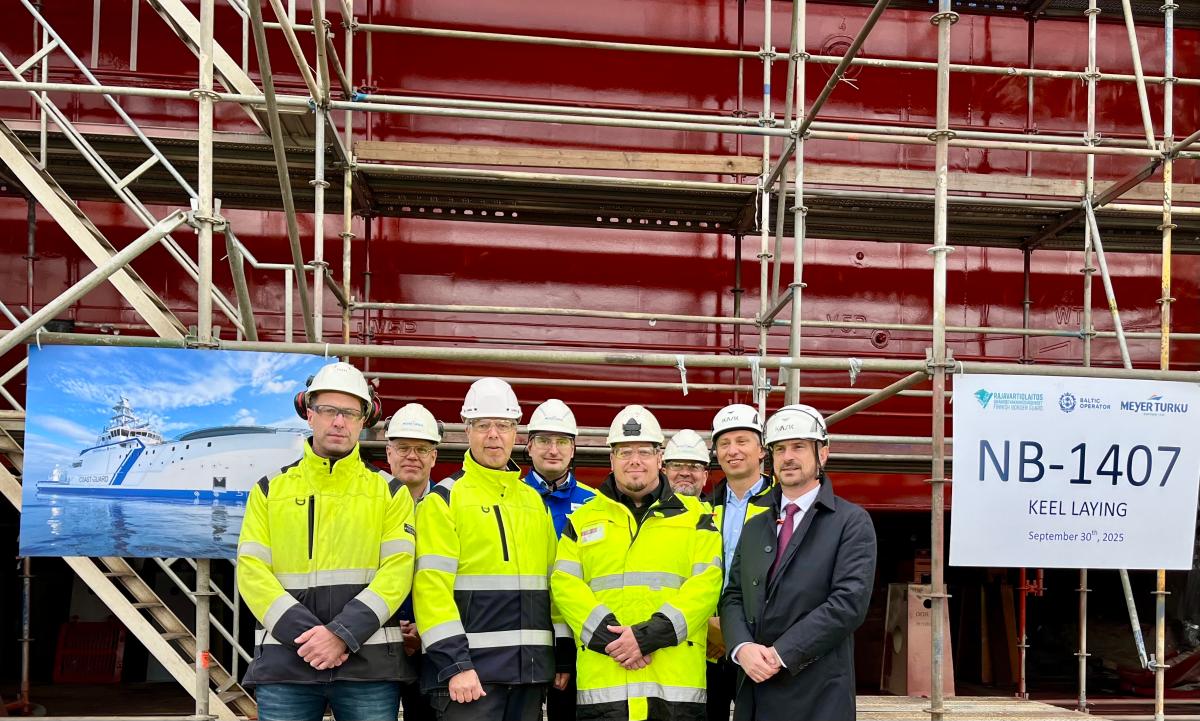
The construction of the Finnish Border Guard’s new patrol vessels, ordered from Meyer Turku, proceeds. The second vessel’s keel laying was celebrated on Tuesday, 30 September 2025.
On 30 September 2025, a keel laying ceremony was arranged at Baltic Operator’s shipyard in Gdansk. The ceremony took place in the presence of the representatives of the Finnish Border Guard, Meyer Turku Oy, Baltic Operator and Bureau Veritas.
The keel laying ceremony is an old tradition. Before keel laying, the customer’s and supplier’s representatives, as well as the representatives of the classification society, placed their lucky coins under the keel beneath the first block. Later on, the coins will be transferred to the completed vessel to bring her luck. This tradition derives from the times of sailing ships, when coins were placed under the main mast for sailing luck.
‘The offshore patrol vessels are built in the facilities of our long-term partner shipyards under the leadership of Meyer Turku, meeting our quality standards. Our common, highly timely project has already proceeded into the stage where we celebrate the keel laying of the second vessel’, the CEO of Meyer Turku, Casimir Lindholm, states.
‘The new offshore patrol vessels will significantly improve Finland’s border security and maritime safety in this demanding security environment that is hard to predict’, the Finnish Border Guard’s Project Leader, Major General Jari Tolppanen, states.
The operational capability of the Finnish Border Guard’s vessels currently under construction is significantly better compared to the old vessels. The vessels’ monitoring and response capabilities during border surveillance tasks, as well as their capabilities in surveillance and protection of territorial integrity in connection to it will be improved. Advanced surveillance systems and data transfer solutions improve maintenance of real-time situation picture and sharing of it. The new vessels also improve the ability to prevent major accidents and the ability to carry out rescue operations. All the vessels have an immediate readiness to control serious environmental accidents, and the total oil recovery capacity will be approximately twice the size of the present capacity. The new vessels will produce low emissions and be energy-efficient.


