Life below water
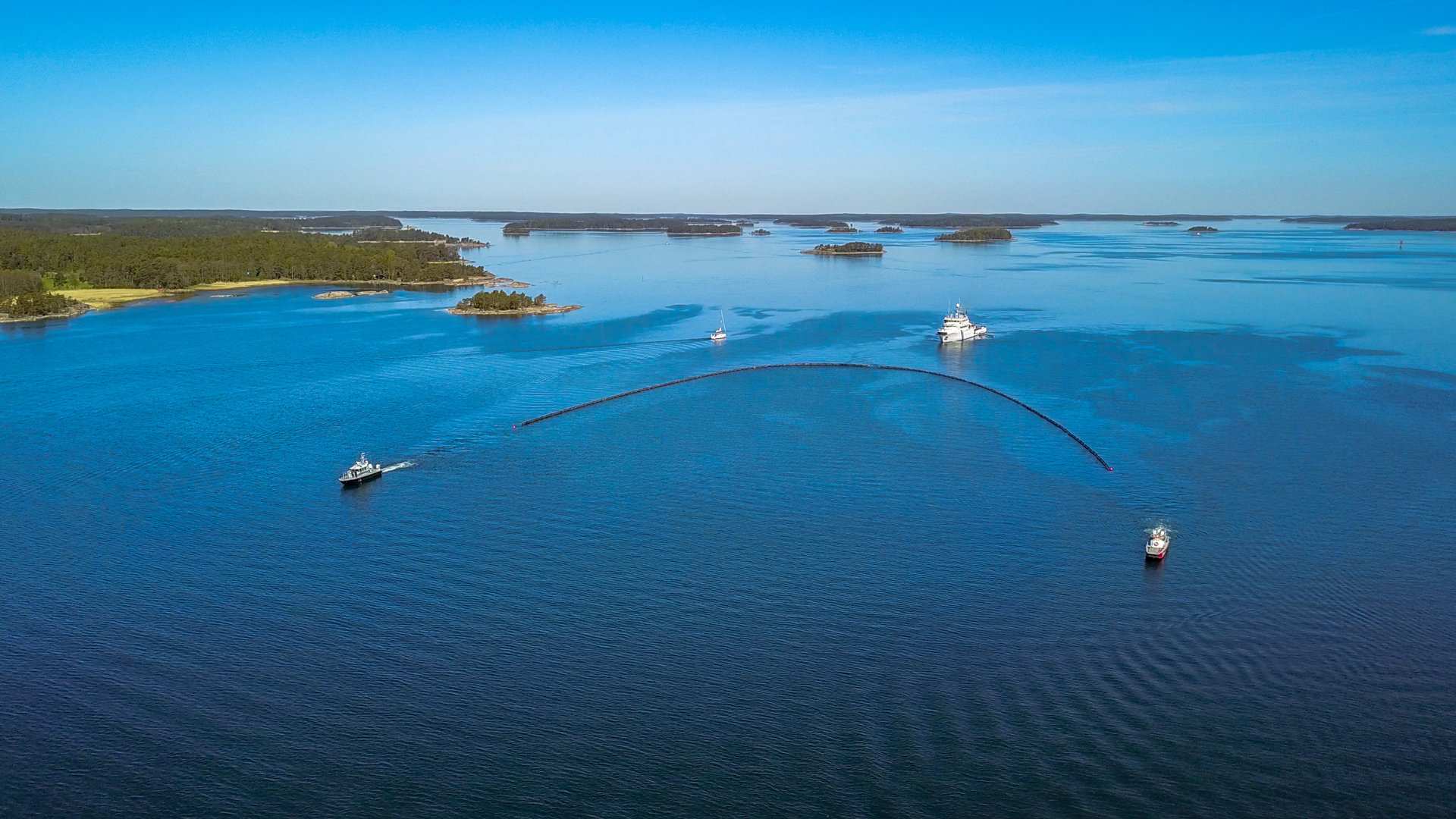
Monitoring the marine environment and investigating ship-source pollution are effective ways of preventing pollution of the marine environment. The preparedness to prevent environmental damage in the open sea is good.
Indicator:
The Border Guard's preparedness to prevent environmental damage (1 - 5). Ability to clean up oil and chemical spills at sea (1 – 5).
Measures and realisation:
The number of detected oil spills has decreased throughout the 21st century, thanks especially to comprehensive monitoring, an administrative oil discharge fee system, and the Act on Environmental Protection in Maritime Transport. At the same time, the risk of a major oil spill in the Baltic Sea is at its highest level in years due to the shadow fleet and GNSS interference.
In addition to surveillance flights operated with the Finnish Border Guard’s fleet, environmental accidents and unauthorised discharges from vessels are monitored with the satellite monitoring system of the European Maritime Safety Agency (EMSA), the EMSA’s RPAS service, and through surveillance flight cooperation with Sweden and Estonia. Environmental preparedness is at a good level thanks to a number of development measures such as the development of planning, preparedness to respond and international cooperation, and the Offshore Patrol Vessel 2025 project will improve it further. In the current situation, preparedness to prevent damage has been targeted based on a risk assessment.
The technical challenges of maintaining the operating capacity of the Finnish Border Guard’s ageing fleet of Dornier aircraft have impacted readiness and the performance of surveillance missions. The agreement to procure new surveillance aircraft to replace the Dorniers was signed in 2024. The new aircraft will enter service in 2026 and 2027.
In the Offshore Patrol Vessel 2025 project, the Finnish Border Guard will receive two modern patrol vessels in 2025 and 2026, which will nearly triple the Border Guard's oil collection capacity and substantially improve its chemical response capability.
The centralised storage of environmental accident response equipment and the improvement of availability continued in 2024. Work also continued on the preparation of a warehouse service concept. The first-line readiness of coast guard stations was enhanced by training on the deployment of equipment in the units. Storage and rapid deployment of equipment will continue to require development and training.
Exercises in responding to environmental accidents were continued in a comprehensive manner, supporting the development of competence. The environmental damage prevention expertise of the Finnish Border Guard and its maritime partners will be developed through MER1, MER2, MCAM and MCRO courses arranged by the Border and Coast Guard Academy and on international courses. Experts from the Headquarters of the Finnish Border Guard serve as trainers on courses arranged by the Finnish Border Guard and third parties in Finland and abroad.
The capability of the Border Guard to respond to chemical spills caused by vessels has been improved in 2024 by drawing up a performance development plan. Measures in accordance with the development plan have been initiated during 2024, but the focus is on the coming years.
The Finnish Border Guard participates in joint development projects in the Baltic Sea area under the Convention on the Protection of the Marine Environment of the Baltic Sea Area (HELCOM) and the Copenhagen Agreement. In 2024, the Border Guard participated in the HELCOM BALEX exercise held in Lithuania and arranged an exercise in Hanko in accordance with the Copenhagen Agreement. The Finnish Border Guard participates in the IMAROS2 project, which started in 2024. The project will examine ways to recover low-sulphur fuels after spillages in cold conditions, for example. In 2024, the Border Guard was involved in preparing the project application for an environmental risk assessment in the Baltic Sea. The project has received EU funding and will start in early 2025. The MERT (Marine Environment Response Tool) information system project has been completed, and an information and situational awareness system that covers all parties involved in preventing environmental damage is now in place.
The sulphur load on the marine environment due to the Border Guard's own activities is reduced further by switching from low-sulphur fuel to biofuels in the vessels (requires additional funding for biofuels).
Indicator:
Share of low-sulphur biofuels out of the fuel used.
Measures and realisation:
The most recent vessels in the Finnish Border Guard’s fleet are capable of using entirely bio-based liquid fuels. Once the vessels in the patrol vessel class have undergone a mid-life update, biofuels will become an option for some or all of them. The switch to renewable fuels would require additional funding that has not been granted.